Monday, May 24, 2010

Technology's Role in 21st Century Education

The teenager clad in sweatpants and Ugg boots shuffles in her seat, disinterested, as her teacher drones on about the major themes found in Shakespeare’s Macbeth. The girl, a senior, started counting down the days to graduation back in December. It’s now March. She only has to endure this state-sponsored "education" for two more months before she’s finally free to move forward with life on her own terms.

Suddenly, she feels a small vibration from the right inside pocket of her sweats. It’s her iPhone signaling that she’s just received a text message. She glances up at the teacher to be sure she’s in the clear, then carefully cradles the phone in the palm of her hand as she begins to read the message from a friend about a road trip they’re taking this weekend to visit her older brother at college. As the girl looks up, she’s startled by the authoritative stance of her teacher staring over her shoulder.

“Jessica, put that phone away now, or it’s mine,” says Mr. Brown. Because Jessica attends Antiquated High School, she is forced to comply with her school’s prohibitive electronic device policy. However, if she attended the forward-thinking Health Sciences High and Middle College high school, she would likely be using her iPhone for academic purposes thanks to a “courtesy policy” that governs the use of electronic devices during school hours (Fisher & Frey, 2008).

Rather than using her phone to solidify weekend plans, Jessica could have been listening to a Podcast on how superstition affects human behavior, or browsing a scholarly text on how blind ambition leads to one’s downfall, another theme prevalent in Macbeth.

Jessica could have been posting a discussion question to her class blog, or using Twitter to respond to a question her teacher posed regarding Macbeth’s most loathsome character. Instead, she’s half-listening to her teacher’s lecture, her body in the classroom, her mind already assembling her outfit for Friday night.

It’s not that Jessica’s ditsy or genuinely disinterested. Her GPA puts her in the top quarter of her class, she regularly does her homework, and she’s generally polite and courteous to her classmates and teachers. Unfortunately for her, Antiquated High School – no different than the majority of American high schools – is failing at its three essential functions, which, according to school technology leader Scott McLeod, are to develop students who are socially functional, economically productive, and able to master the dominate information landscape of their time.

Jessica’s classroom is aligned in rigid rows where students sit isolated, tasked with individual desk work that requires little collaboration or use of resources beyond their text and the teacher’s lecture notes. In this class, Jessica isn’t able to use the latest Web 2.0 tools because her teacher doesn’t know much about technology and has little desire or incentive to learn. And even if he did, her school’s Internet filter blocks blogs, wikis, Ning, Twitter, Facebook, and other social, academic, and compositional Internet resources.

Because Jessica is able to memorize information, she does well on quizzes and tests. Because she sufficiently models her teacher’s writing exemplars (most of which are provided by the state department of education) she scores above-average on her essays. Jessica’s high grades have given her an inflated sense of self as a student. What Jessica lacks is an independent and curious intellect. Rather than break new ground and take chances, Jessica plays it safe while keeping risk-taking at a minimum.

Heidi Jacobs, author of Curriculum 21: Essential Education for a Changing World, would argue this problem is not entirely Jessica’s fault.

Schools tend to teach, assess, and reward convergent thinking and the acquisition of content with a limited range of acceptable answers. Life in the real world, however, demands multiple ways to do something well. A fundamental shift is required from valuing right answers as the purpose for learning, to knowing how to behave when we don’t know the answers – knowing what to do when confronted with those paradoxical, dichotomous, enigmatic, confusing, ambiguous, discrepant, and sometimes overwhelming situations that plague our lives (Jacobs, 223).

This lack of ingenuity and creativity will hurt Jessica’s chances of employment in the long run. Because she hasn’t learned to tap the power of the Internet for research, self-publishing, or networking, she’s already miles behind the students at Forward Thinking School District who have been cultivating positive electronic personas since elementary school.

Even if Jessica is able to land a good internship during college, she is going to require extensive training before she’s well-versed in the electronic networking and publishing software used by her company. Rather than coming into this new work environment as a leader and a source of innovation, Jessica is seen as unprepared and burdensome.

Some say schools are responsible for preparing students for the “real world.” Others take this a step further and say school should be the real world. Antiquated High School and others like it are stuck in the past, preparing students for jobs that no longer exist. Their true responsibility is to prepare students for jobs that have yet to be created, and they are failing, miserably. It is time for today’s educators to get serious about giving students a malleable set of skills they can apply five, ten, and even twenty years down the road.

This means that students can work effectively in groups. It means they can analyze, criticize, create, deconstruct, and synthesize. It means they know how to use technology for serious, academic research and investigation, not just social networking and gaming. Students will not learn these skills unless, we, their teachers, undergo a focused, constructive, cumulative initiative that challenges the current educational paradigm and reshapes it for the 21st century.

This cannot happen unless the federal and state governments renew their commitment to education, moving away from drill-and-kill instruction and toward constructivist, open classroom environments where teachers facilitate learning though technology, collaboration, and exploration. The days of the teacher as the “sage on the stage” are gone. Our new roles are to serve as guides through an increasingly complex and ever changing digital maze of information.

We can’t lead our charges into this new horizon with the tools of the previous century. To remain relevant, school districts must acquire the digital hardware of today’s workplace, train teachers on its use in the classroom, and then give students the freedom to explore, experiment, and harness their skills as navigators, evaluators, and creators of tomorrow’s world.
 
References

Bonk, C. (2009). The world is open: How Web technology is revolutionizing education (1st ed.). San Francisco, CA: Jossey-Bass.

Frey, H. & Fisher, D. (2008). Doing the right thing with technology. English Journal. 38-42. Retrieved from http://www.ncte.org/journals/ej/issues

Jacobs, H. (2010). Curriculum 21: Essential education for a changing world. Alexandria, VA: Association for Supervision and Curriculum Development.

Herrington, A., Hodgson, K., & Moran, C (Eds.). (2009). Teaching the new writing: Technology, change, and assessment. Berkeley, CA: Teachers College Press.

McLeod, Scott. (2010, March 16). Notes from India – My TEDx talk [Web log post]. Retrieved from http://dangerouslyirrelevant.org/2010/03/notes-from-india-my-tedx-talk.html

Metiri Group. Multimodal Learning Through Media: What the Research Says. (2008). Retrieved from www.cisco.com/web/.../Multimodal-Learning-Through-Media.pdf

National Council of Teachers of English. Writing in the 21st century. (2009). Retrieved from http://www.ncte.org/press/21stcentwriting

State Educational Technology Directors Association. Maximizing the impact: The pivotal role of technology in a 21st century education system. (2007). Retrieved from http://www.setda.org/web/guest/maximizingimpactreport

Seniors 'Articulate' on final day

Today was my seniors' last regular day of class. In both my World Literature and Journalism classes, we concluded the year with a game of Articulate. Featuring elements of both Charades and Taboo, the game requires players to describe to their team members a variety of people, places, things, and actions within a 30-second turn.

It's exciting, fast-paced, and rewards students for being knowledgeable and - you guessed it - articulate. When students get on a roll and they're in-sync with each other, teams can guess five or six items within the half-minute window. When students get stumped or spend too much time on one particular card (they're allowed to skip once), one or sometimes no correct answers are given.

I enjoy playing it with my students because it gives those who have different strengths and areas of expertise a chance to put their skills to use. For example, when the "nature" card comes up, students who are good in biology and the sciences are the best describers, as they're able to quickly break down the item on their card for their group to guess. The same goes for the "geography" and "people" cards. Students with specific knowledge can help their teams win, their smarts rewarding them with instant social capital.

The game is also great for team building. In my Journalism class, we played seniors vs. underclassmen, and the seniors narrowly scraped out a victory, despite having almost twice as many players. The members of the class of 2010 left the game with their dignities in tact, while the sophomores and juniors had every right to feel proud as they held their own.

Saturday, May 1, 2010

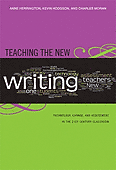
Teaching the New Writing


Teaching the New Writing is a compendium of teacher anecdotes, lessons, and insights on what writing instruction looks like in the 21st century classroom. Edited by UMass professors Anne Herrington and Charles Moran, and sixth grade teacher and blogger Kevin Hodgson, the book offers educators of all levels an opportunity to learn from colleagues as they go about bringing 21st century skills into their classroom.

Included in the book is an index of technology terms ranging from multimodal composition and vodcasting to digital storytelling and weblogs. Seventeen teachers representing a full range of grades and classes across the education landscape contributed to the book, which features a variety of student work to go alongside lesson plan notes and reflections.

The book is divided into three sections. The first spans the elementary and middle school years, the second focuses on high school, and the final chapter extends to college. Given this range, Teaching the New Writing is apt for a variety of audiences, including classroom teachers, parents, administrators, curriculum coordinators, and pre-service teachers looking to gain a holistic glimpse of writing instruction in the 21st century.

Some of the choice chapters include Chapter 4: Digital Picture Books – From Flatland to Multimedia, Chapter 5: Be a Blogger – Social Networking in the Classroom, Chapter 6: Poetry Fusion – Integrating Video, Verbal, and Audio Texts, and Chapter 12: Technology, Change, and Assessment – What We Have Learned.

One of the core concepts of the book is that we need to rethink our definition of writing. In fact, we should replace it with the word “composing,” and consider composition as the creation of “texts that might include words, images, sounds, and hyperlinks that connect any and all of the above to other words, images, sounds, and hyperlinks” (199).

As far as integrating technology into the classroom, the authors recommend patience, as it will take time for new technologies to intertwine themselves with curriculum. The authors warn that business-as-usual professional development will not work.

“The usual kind of staff development – the one-shot training workshop mandated by the principal or superintendent – will not produce the desired effect, or perhaps any effect at all” (203). Until that model changes, teachers will bring technology into their classrooms gradually, over time, and at different rates. Membership in professional organizations focused on technology integration and attendance at regional and national workshops will be vital to providing teachers with the training necessary to bring their pedagogy to the 21st century.

Sunday, April 25, 2010

Online education

For those interested in learning more about Boise State University's EDTECH graduate program, take a look at the video below. I'm only two classes into my degree, so I haven't had a chance to take a class that makes use of Second Life. It certainly looks like it could have promise.

I think good educators draw on a variety of resources and strategies to get students engaged in the curriculum. Could the virtual world of Second Life be one of these resources I use? Sure. Does this mean that the concrete here-and-now goes out the window? Of course not.

As an online student, most of my learning occurs through a pixilated environment. As a high school classroom teacher, the majority of my interactions with students are face-to-face; this despite the fact that they spend one-third of their day interacting with screens. While there is definitely a benefit to incorporating virtual worlds and online interaction into my teaching, it's worth noting that some of the most meaningful classes I've had have occurred in the format of an old-fashioned Socratic seminar

Teacher and student

With the end of the school year in sight, it's no surprise that I find myself busier than ever. What's different this year than previous years is that not only am I juggling curriculum and assessments for the five classes I teach, I am also busy completing work for two classes I am taking for my master of educational technology degree.

I have about one week to write a major research synthesis essay for one class and create an in-depth WebQuest for another. It is going to be an arduous stretch. I will complete it, though, and thankfully will have a little break before I once again juggle the roles of student and teacher in the fall.

As those of you who are teachers know, teaching is a full-time gig. I'm at school by 6:45 a.m., and often stay past 4:00 p.m. And unlike most professions, my work day doesn't end when I get home. There are always lessons to plan, assignments to correct, and constituents to get back to. This is just the reality of being a teacher. While it's time consuming, it's also wholly engrossing, meaningful, satisfying work. If I didn't enjoy what I do, I wouldn't do it.

Because I give a lot to my job, I have a limited number of hours to give to my wife, myself, friends, and family. With two graduate classes also in the mix, it's safe to say that my cup is near overflow. Fortunately, I've been able to keep sipping away before any drops spill, but it hasn't been easy. Knowing that a respite is near helps motivate me to take the final necessary gulps.

Although my graduate work will soon be over, my responsibilities as a high school English and journalism teacher will continue through the end of June. When we return to school tomorrow, my 9th graders will be turning in poetry anthologies, and my seniors will be submitting major research papers. The journalism kids will assess their latest issue and begin planning their final paper of the year. With the seniors finishing at the end of May, there will be a changing of the guard for the last edition, as underclassmen take on the major editorial roles.

My seniors' last unit is Lord of the Flies, which we'll start tomorrow. The freshmen will end with Speak and Romeo & Juliet. Best wishes to students and teachers everywhere for a swift and fulfilling journey to the finish.

Wednesday, April 14, 2010

A digital initiative

A few weeks ago I was selected to be part of an innovative team of educators who will be responsible for laying the groundwork for an online high school in Massachusetts. Thanks to a $400,000 grant, pockets of teachers from across the state will develop quarterly online courses that can be administered to students via computers through the Internet.

I met recently with five other content area teachers at a regional educational collaborative. There we were given laptops and offered an opportunity to explore various Web 2.0 tools. Once we become familiar with the electronic options available to us, we'll conceptualize how to best put them to use to teach students the curriculum they need to earn a high school diploma.

The majority of my work will be done in the fall, when I will actually create the class using the Moodle content management system. Once the course is set up, I will administer one pilot section of it in the spring. The goal is to fine-tune the course for the state so that eventually, other tech-savvy, certified educators will be able to teach the course to students from across MA.

Online learning has a number of benefits. The asynchronous nature allows for students to engage with the content during the hours that are most suitable for them and their lives. The discussion-board style discourse gives all equal voice. This is a contrast to brick-and-mortar classrooms, where the most vocal or loquacious students run the risk of dominating classroom conversation. Rather than get caught up in the heat of the moment, posters also have a chance to reflect on what it is they are learning, and how exactly they want to portray an idea or show their understanding of a concept.

Given that students spend nearly eight hours per day in front of screens, online learning also provides comfort and familiarity. The main drawback, obviously, is that students miss out on an opportunity for face-to-face contact and interaction. It's hard to truly get a"feel" for your teacher and classmates until you actually spend time with them in the same physical place.

One nice component about the course I'm piloting is that the students will be in a room with other students taking the class, and they'll have the assistance of a paraprofessional. Thanks to Skype and other video conferencing programs, students and paras will be able to converse with the "behind the screen" teacher to ask questions and receive immediate feedback.

As an aside, one of the teachers in my cohort was an old friend from my undergraduate days at UMass whom I hadn't seen in more than 10 years. It was great to reconnect with her, and served to further drive home the notion that it really is a small world, and we are connected in more ways than we realize.

Photo credit iStockphoto

Sunday, April 4, 2010

A teen summit on bullying

Area teenagers discuss bullying with reporters from the Daily Hampshire Gazette. For those looking for a deeper understanding on the root of bullying behavior and its effects, this is a worthwhile view.

Restive times

It's been the kind of day that's evocative of summer. Balmy temperatures, neighbors operating lawn-cutting machines. The smell of burning leaves and twigs from a nearby brush fire. I spent much of the day outdoors, patching a divot in the driveway, assembling a shade umbrella for the back porch, and wiping off the deck chairs and table. Physical tasks to quell a restive mind.

A conglomerate of national and international media gathers outside my high school as a DA's investigation into a student's suicide yields charges and arraignment hearings. A school community desperately tries to heal while an impassioned public calls for heads to roll. Slick and self-righteous media figures feign compassion as they grasp at half-truths and call for justice.

It's the story du jour, the outrage of the moment, the latest flaming spectacle. Somewhere under the media light lies nuance and truth. Yet the cameras and microphones pick up simplistic anecdotes, condensed for the masses into 30-second digestible bites. All flash and sensation. Emotion and conviction. We know. We know. We're hundreds of miles away, yet we know. We'll give you your objects of ire. See where our finger points. We're infallible. Omniscience is our coxswain.

Despite the media's barrage, life goes on. Students come to class ready to learn. Their resilience is remarkable. Is learning just a convenient distraction, or is it the nature of the teenage mind to be elastic and malleable, always seeking to absorb a new experience and perspective as world view is created inside expanding neurons?  

Existential thoughts color day-to-day interactions. Justice, redemption, remuneration, repudiation. Reactions, accusations, justifications, recalculation.

Next week will bring arraignments and pleas. A community braces. A nation - and a world - awaits.

Wednesday, March 17, 2010

Inventing the new paradigm

At a recent TED event, school technology leader Scott McLeod admonishes the current educational establishment for sticking its head in the sand and failing to adjust to the digitally and globally connected world.

In this video, McLeod describes 21st century classrooms that look nearly identical to the classrooms of 1890. He calls for a rethinking of curriculum, instruction, and assessment, and states that every kid needs access to a computer.

"It's a digital world. We're going to have to stop pretending that it's a paper and pencil world in schools," McLeod says.

As currently constructed, school environments are set up to prepare kids for the last 50 years, not the next 50 years, McLeod observes. He says schools are failing in their three essential functions, which are to develop students who are socially functional, economically productive, and able to master the dominate information landscape of their time.

"We can see quite clearly that we have some disconnects that cannot continue to be maintained."


I happen to agree with a lot of what McLeod talks about. It is for some of these reasons that I chose to go back to school for a master's degree in educational technology.

As I wrote about recently, it's made for a full year. In the end, though, the effort will pay off, as it will help me provide my students with a 21st century education that's relevant to their lives, needs, and the world they will inhabit.

Sunday, March 14, 2010

Power outage

At around 4:00 in the morning, we lost power. Last night was an evening of fierce winds and pounding rain, and eventually the electric lines in my neighborhood surrendered.

No power meant no leisurely Sunday morning hot coffee. The blender that usually prepares a berry smoothie sat silent and forlorn. The pile of laundry in need of washing waited idly in its basket. Because we get our water from a private well - whose pump depends on electricity - our faucets were dry.

Rather than sit around and panic, my wife and I did what any other couple would do in our situation. We went out to breakfast.

We hoped that upon arriving home, power would be restored. Alas, it was not. When we finally received notice that we'd need to wait until evening, we settled into non-electric tasks. For me, this meant finally reading the stack of old newspapers that had gone neglected on the coffee table since January.

Periodically I kept hoping the power would come on earlier than expected so I could catch the Celtics/Cavs game. Fortunately for me, a man who bleeds Green, I wasn't able to tune into another disappointing loss for what's quickly becoming an embarrassing team.

Being without power isn't so bad, but on a day like Sunday when you need it for a myriad of tasks, it's quite an inconvenience. I say this with a grain of salt, though. I thought a few times about earthquake victims in Haiti and Chile and quickly regained perspective. I live a charmed life, with all the comforts and amenities one could ask for. I have shelter, health, and family. My choice occupation brings stability and a sense of purpose.

While going without the things we rely on can be a hindrance, there's a renewed appreciation that awaits when what was missing is finally restored.

Sunday, March 7, 2010

Sylvanic scurryings... and basketball

This afternoon I went for a jog through the woods behind my house. While this certainly isn't groundbreaking news, in the larger scope of things it signals that spring is on its way, as the snow was all but melted. I am ready for longer and warmer days, and ready to recommit to an exercise regimen.

It's tough. Many of us make New Year's resolutions to improve our activity level at a time when nature's creatures are dormant and the weather makes it easy to stay inside and lounge. Aside from personal health, another more pressing motivation for me to stop slothin' around is this Thursday's student/faculty basketball game. Yup, I'm playing. I hope to score a few points, make a couple stops on defense, and not completely embarrass myself.

It's likely the students will beat us, although, who knows? I've heard some of the faculty members have game, and if a couple of us get hot, anything's possible. If the students push the ball and run every time, they'll likely have an easy victory. But it we can get them to play slow-it-down basketball, we have a chance. I really don't care about the outcome of the game. What's more exciting is the chance to interact with some of my colleagues as I attempt to relive those glorious days of my high school rec league.

Saturday, March 6, 2010

Poetry and promise

Shorty I will be leaving to attend the Massachusetts Poetry Out Loud semi-final event in Springfield, where one of our students will represent our high school in the annual recitation contest. Three years ago I brought Poetry Out Loud to our school. While participation in the event hasn't been as robust as I would like, each year we've been able to field a competitive contestant.

Not only will my morning be filled with poetic recitations from some of the areas brightest high school kids, but the sun is out and temperatures may creep into the 50s. I'm looking forward to getting outdoors later, maybe to shoot some hoops, go for a jog, or explore the rail-trail behind my house. Winter for most of us here in Mass has been - for lack of a better word - weak. When other parts of the country were getting pounded with powdery blasts, we either had rain or nothing at all.

I wouldn't mind experiencing one solid winter storm before officially yielding to spring, but at the same time I'm also ready right now for the regenerative spirit that comes as the earth rotates toward longer and warmer days.

Thursday, March 4, 2010

Tuesday, March 2, 2010

Oh boy

Midterm grades to compile and enter. Course work for my Master of Educational Technology degree to complete. An interview tomorrow to help develop and pilot a Massachusetts Online Curriculum. It's already been a 12-hour day, and there's still much to do.

This, of course, is in addition to daily lesson plans that need to be created, parent e-mails and phone calls that require timely response, and ongoing student work that must be read and evaluated. And then there's special education forms and field trip forms and writing assessment forms and other forms whose names escape me.

Oh, but surely you must have time in the school day to do these things, right?

I have 55 minutes to make photocopies, clean my boards, write the new day's agenda, write the new day's homework, organize handouts, and use the bathroom before a bell rings and students begin to fill my room.

In education, there are essential things that MUST get done each day. What you don't accomplish in your 55 minutes becomes a responsibility that has to be completed on your own time. While I love the work - it's engaging, rewarding, fulfilling, and stimulating - I sometimes wonder if it's burning me out. Since my graduate classes started, I haven't had time to maintain my New Year's Resolution of jogging consistently. At some point, I'm going to need to give more consideration to my health. And if my wife and I decided to ever have kids, I have no idea where I would find the time to be a father given my current schedule - something would definitely have to give.

If we had kids, our children would need to be at the top of our priority list. As a teacher, you see what happens when children are neglected and their parents aren't there for them, and it's trying and sobering. Life is hard stuff, and children need mindful ambassadors to lead them through its peaks and valleys. If your parents aren't responsible, nurturing, and involved, you're at a distinct disadvantage.

Being an adult is about being able to juggle many things with finesse, dexterity, and care. It's about meeting multiple priorities and finding balance. Right now that balance seems elusive, but I'll eventually muddle through and find equilibrium.